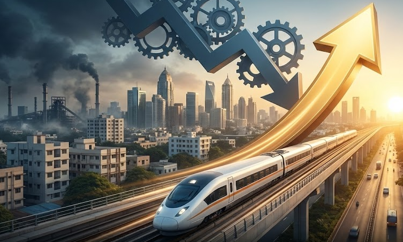
A Rare Bright Spot in an Uncertain World:
As much of the global economy grapples with slowing growth, persistent inflation risks, and geopolitical uncertainty, India stands out as a rare exception. While developed markets adjust to tighter financial conditions and weaker consumption, India continues to demonstrate resilience driven by domestic demand, structural reforms, and long-term investment momentum. This divergence is not accidental. It reflects years of policy recalibration, digital transformation, and a demographic advantage that few large economies still possess.
Domestic Demand as the Growth Engine: Unlike export-dependent economies, India’s growth is increasingly powered from within. Rising incomes, urbanization, and expanding consumer aspirations continue to support consumption across sectors — from housing and automobiles to financial services and digital platforms. Government-led capital expenditure has added another layer of stability. Infrastructure investments in roads, railways, ports, and energy are not only stimulating short-term economic activity but also strengthening long-term productivity. This combination of public spending and private consumption has created a buffer against global slowdowns.
Manufacturing, Supply Chains, and the China+1 Shift:
One of the most significant drivers of India’s current momentum is its positioning in the evolving global supply chain. As companies seek diversification beyond China, India has emerged as a credible alternative — particularly in electronics, automotive components, pharmaceuticals, and specialty chemicals.
Production-linked incentive programs, improving logistics, and a growing manufacturing ecosystem are gradually translating policy intent into measurable output. While challenges remain, the direction of travel is clear: India is moving from a services-led growth model toward a more balanced economic structure.
Digital Infrastructure and Financial Inclusion:
India’s digital public infrastructure has quietly become a competitive advantage. Unified payment systems, digital identity frameworks, and widespread mobile connectivity have lowered transaction costs and expanded formal economic participation. For businesses, this has created scale, efficiency, and transparency.
For consumers, it has enabled access to credit, services, and markets previously out of reach. In a slowing global economy, such efficiency gains provide a powerful growth multiplier.
Capital Flows and Investor Confidence:
Global investors are increasingly viewing India as a long-term allocation rather than a tactical trade. While short-term capital flows remain sensitive to interest rates and global risk sentiment, structural foreign investment continues to Favor India’s growth narrative. Strong corporate balance sheets, improving governance standards, and expanding profit pools across sectors reinforce this confidence. The focus is gradually shifting from cyclical plays to businesses aligned with India’s multi-decade transformation.
Risks That Cannot Be Ignored:
India’s growth story is compelling, but not immune to risk. External shocks, commodity price volatility, climate challenges, & global financial instability can still impact momentum. Additionally, sustaining high growth will require continuous progress in job creation, skill development, and regulatory efficiency. The next phase of growth will depend not just on policy ambition, but on execution consistency.
The Bigger Picture
In a world searching for stability, India offers something increasingly rare: scale combined with momentum. Its growth is not a short-term rebound, but part of a broader structural shift underway.
As global economies recalibrate, India’s trajectory suggests that while the world slows, opportunity does not disappear — it relocates.